Showing posts with label Sylvia Plath. Show all posts

Friday, 21 January 2022

The New Yorker, January 17th 2022

I am a great fan of the public library system, and have written here about my first library book, which I "borrowed" (in fact my mother handled the entire transaction) at the age of five.

And here about the efforts of the public library to interest me in e-books.  My scorn, expressed ten years ago, has been replaced by delight, especially since the pandemic when the public library buildings were closed for months on end. Many wonderful books could be accessed, at the touch of a phone screen, and audiobooks could be downloaded free of charge. I have written here about the many audiobooks I listened to last year, and every single one was a free download from one of two library websites. One is called "Borrowbox" and the other is called "Libby".

A further delight offered by the library Libby app is the unlimited quantity of magazines available to read online. Downloading a magazine does not affect the number of books or audiobooks you are allowed to borrow at any one time.

You can read the Radio Times, (this does require some patience in scrolling, as the pages are so full of tiny boxes).  You can read "Hello" (if you want to catch up with the latest pictures of William and Kate). You can read "The New Yorker".  

Now, I spent much of my youth reading stories from The New Yorker, anthologised (my copy is shown below)
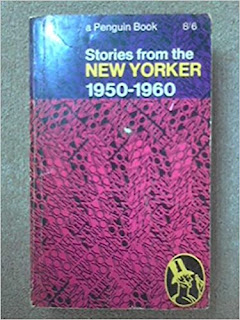

in paperback form. I still have a copy of this book, in this exact edition, increasingly fragile and yellowing, as it dates back 60 years. My ideal short story, as showcased in this collection,  is encapsulated by a conversational ambience, a comfortable feeling of fireside chat, a homely, yet educated tone, (one often emerging from an older, immigrant, poverty-soaked childhood), an emphasis on family, childhood memories, and family relationships.

When I read the complete edition of Sylvia Path's letters, I was intrigued to note that one of her great ambitions was to have a story published in The New Yorker.  The magazine accepted many of her poems, but her ambition for a story was not realised.  This was comforting to me. When a writer has become a legend, it is sometimes hard to imagine that they ever failed at anything.  This brings Sylvia to life as an ordinary human being, a new perspective.

So when I discovered that I was able to access every weekly edition of the magazine online, free, and peruse at my leisure, I was delighted.  I homed in first on the stories. Stories these days encompass every type, every background, every type of voice. Some of them I just can't find interesting.  

At other times, the story is pure genius, which is hard to define.  An example is anything by the Chinese born scientist, Yiyun Li. Here is a novel which I strongly recommend, as a good indication of her political depth, historical knowledge, and emotional intensity. You can also listen to an episode of BBC World Book Club here, in which she talks about this novel.  Yiyun Li was born in China, so brings a very different background to the table, also being a scientist she is not the usual type of writer. 

Many stories in The New Yorker, however, appear to me to be both pointless and boring.  If nothing happens, I struggle to see why the story is deemed to be worthy of publication.

I am an eternal seeker after the next interesting story, so I persist.  This week I am reading the magazine edition of 17th January, and have devoured the first of my chosen items of interest, an interview with the New York based writer, Hanya Yanagihara. 

As a subscriber to "Goodreads" and "Guardian Books" website newsletters, I have already come across this author's name as one to look out for on lists of the best books to be published in 2022. Her new book is called "To Paradise." 

She is best known for her second published book, which appeared in 2015, called "A Little Life".  I have owned a copy of "A Little life" for some years now, and have yet to read a page of it.  The fact that it is 700 pages long is of less importance than the reviews, which all emphasise the content as being terribly upsetting, largely about appalling physical torture and abuse. This has put me off.  The new book, following three timelines, 1892, 1992, and 2092, in New York, sounds interesting, so I read the interview.

As is sometimes the case, I found the author herself (as portrayed in the interview) far more intriguing than the book itself.

She spent fifteen years writing her first book, "People Who Live in Trees"which seems like an incredible marathon.  A triumph of self-belief. It was little thought of at the time, and was quickly completely overshadowed by her second, "A Little Life".

She spent 18 months writing this, her second book, a 1,000 page long manuscript, writing between nine and midnight every evening, and through the weekend.

She lives in an apartment containing 10,000 books. She is 48. 


Why do the numbers grip me more than the content? I am not sure.  All I can say is that I find her own life, as viewed and interpreted by the New Yorker interviewer, far more fascinating than the idea of reading a lengthy tome about torture and abuse, however well reviewed.  I went to my upstairs bookcase and brought down my copy of "A Little Life" to my downstairs bookcase, in case I should feel the need to dip into it.  I haven't felt this need yet.

I think what I really find fascinating is how diverse writers are, how their lives are so different from mine, how they scintillate with visions which they translate into words.  Some of these word-pictures I find entrancing, some moderately interesting  and some completely boring.  But the individuals themselves, the writers, each one completely an entirely unique human being - now THAT is interesting.


Saturday, 4 April 2020

100 Good Things About Growing Old #35 - Further Chances to Revisit the Icons of One's Youth

Years ago, in the sixth form (circa 1970) we read poems by Sylvia Plath.  I always found them rather too difficult, although I did buy my own copy of "Ariel", which surprises me somewhat, as these days I either borrow from libraries or look online, at Poetry Foundation.  I found Sylvia's actual life more interesting, and bought a copy of "Bitter Fame" (pictured below), in the 1980's.   

Since then, new material has been published which was not then available.
One item is this, my first "Lockdown Reading" book:


Lockdown Reading:  969 pages

This has been on my "to-read" list since it was published in 2018. I took it out of the library in late January this year, and had already renewed it three times, thus reaching my limit.  Then lockdown closed the library, and I have it for an indefinite further period.

The book is long, but easy to read.  In fact, it reads like an epistolary novel.  It follows the life of Sylvia from shortly after her marriage to Ted Hughes until the week before she took her own life (in February 1963).

The introductory piece by her daughter, Frieda Hughes, is touching and illuminating.

It's Sylvia's voice, though, Sylvia's story, and how mesmerising, how vivid, how kaleidoscopic her view of life.

Sylvia's phenomenal energy, her love of food, her love of life (yes, she does come across as having loved life), her love for her mother, for Ted, and for her daughter, Frieda, all shine like beacons.

Most of the letters are addressed to her mother, Aurelia, but with additions, and without the censorship practised in the original "Letters Home" (published in 1975).  Aurelia, (as the linked, quite horrible and extraordinarily scathing, reviewer points out), wanted to present a particular view of her late daughter. The new 2018 book is a no-holds-barred version.

Yes, Sylvia did have a difficult relationship with her mother, (who doesn't?)  and sometimes her selfishness is breathtaking.

She is at times sycophantically the small daughter, craving her mother's indulgence.  At other times she is variously patronising, dismissive, critical, extremely demanding, and even controlling.  (At one point she gives her mother a list of hints on how to make a living as a short-story writer).

At the end, her poor mother is absolutely desperate, forseeing disaster after Ted's departure, leaving the raw, wounded and vulnerable Sylvia alone with a baby and a toddler. Aurelia, anguished, telegrams to the midwife in North Tawton, (Sylvia being still in Devon in October 1962),  begging her to visit Sylvia "now, and get woman for her.  Salary paid here."  This is a voice of maternal anxiety with which, as a mother of grown-up daughters, I can totally empathise.

Sylvia replies to her offers of money and support with absolute fury. "Will you please, for goodness sake, stop bothering poor Winifred Davies!  You have absolutely no right or reason to do this, and it is an endless embarrassment to me .... Will you kindly leave her out of it?"  and more in the same vein.

Sylvia then goes on, in the same letter, to rant about Ted's "insanity and irresponsibility", reports that she has cooked roast beef and apple cake and entertained the bank manager's 14 year old son (who has read Ted's poems at school).  She thinks she is "well-liked here, in spite of my weirdness" and is convinced she will be able to achieve everything if only she can get a good nanny and a London flat.  Everything, energy, food, mania, delusion, it's all there, as it is in so many of her letters to her mother.

I think her mother knew best, but as with many mothers of daughters, she was told not to interfere.

Aurelia knew the real Sylvia, who, as others found to their cost, maintained a front of being the golden, all-achieving, popular American girl.  Underneath, as her poems disclose, she has sharp hurts which will never heal, and very dark thoughts on death.

In spite of it all, I like Sylvia.  I still find her poems on the difficult side, and this is because she was so much cleverer than me.  Had I met her at university, she would have terrified me.

But I like her a whole lot more than Ted.  I never was a fan of his work, and the revelations that have emerged over the years about his personal behaviour have made him even less appealing.  I've written before on this blog about how more recent work has revealed just how unpleasant Ted was.  At the time of Sylvia's death, the prevailing narrative, as exemplified in the biography "Bitter Fame", was that Sylvia was completely mad, and Ted a man provoked beyond endurance.


How untrue that was, is revealed by Professor Sir Jonathan Bate, in his "unauthorised" biography I refer to in that post.  I'll give just two examples:  Ted's sexual adventures with the woman for whom he left Sylvia, Assia Wevill, were so extreme that he ruptured her.  And on the night that Sylvia died, he was in bed with a third woman.

It's always been known that Assia killed herself in the same manner as Sylvia, and, far more shockingly, also killed her four-year-old daughter, Shura.

How toxic does a man have to be, to have that happen twice in a lifetime?

Even after all that, Ted managed to maintain his status as the woebegone, bereft husband, and became the poet laureate.  The women who scratched out the name "Hughes" on Sylvia's headstone in Yorkshire, were dismissed as mad feminists, further examples of what a decent man has to put up with.

As far as I am concerned, however, Ted is most damned by his own words.

Another book that wasn't available in my long-ago youth, is a collection of his own letters (pictured above, published 2007).  I actually bought my own copy of this book, some years ago, but have not been able to read all of them.  Unlike Sylvia's letters, which amuse, grip, enthral and describe, Ted's are much less interesting.  In many he comes across at times as a lacklustre individual.

(To Sylvia, various letters October 1956):  ..."I have done nothing.  Almost nothing. I composed a rather silly plot for a TV play ...."  "What I have done today.  A great deal of nothing..."  "This afternoon, stupefied, I lay on my bed in a half dream from three until seven ..."

Later, after the split, he is cruelly matter-of-fact to his sister Olwyn. (Late summer 1962):
"The only help I need is cash - in an account of my own ....my only concern is to swell a private account" .....   

As two of my friends now in their late sixties have attested, a private bank account in which to salt away an escape fund is the first requirement of the errant husband.

And even more cruelly to Olwyn, September 1962:
" Yes, it's just like her to employ a snoop ...(on his affair with Assia).

Then, tragically, in view of what actually happened:
"You're right, she'll have to grow up - it won't do her any harm".

That did it for me.

I have sifted through his later letters, but not with the enthusiasm I have for Sylvia's.  His long missive to Anne Stevenson, giving his own version of many of the events written about in her biography, "Bitter Fame", is interesting as an alternative view, but does not exonerate him from being damned with his own words in places.  His letter to his son Nicholas, dated 1986, when Nicholas would have been about 24, is astonishingly black and gloomy about life.  Nicholas took his own life in 2009 (two years after the collection of Ted's letters was published).

I find my attitude to Sylvia's poetry has not changed since my sixth-form days: it is still difficult, and dark.  But my attitude to her as a person has had much light shed.

To go back to the idea of what it would have been like to have been her contemporary at university: yes, she would have been scarily energetic and bright, but how bracing, and what good advice she gave!

Here is her letter to her friend from Wellesley, Lynne Lawner, dated October 1957. Lynne has arrived in Cambridge (England, not Massachusetts) in October,as Sylvia did two years before, and she has complained that she is "freezing, sick and uncertain". 

Yes, anyone who arrives at Cambridge in that season feels frozen, and the first term at a new university does leave one sick and uncertain.  Sylvia is bracing; "Well, so was I. Cambridge is worth this ....."

Sylvia remembers the feeling of being out of one's depth:   "If you are now feeling as ignorant, unread, unintellectual as I did ... you would do well to discipline yourself .... simple discipline helps a bit...." 

If only someone had told me this in October 1972, when I arrived at a different university on the freezing Eastern side of England, feeling ignorant and out of my depth.  I failed to discipline myself, and have paid the penalty throughout my life since. 

Her final words are even better:  "Practical advice about the miserable cold. Wear stockings ... and wool kneesocks over them .... Get a hotwaterbottle and pre-warm your bed at night ..." 

And don't skimp on the gas meter, and go out and buy proper food, don't rely on the ghastly college offerings.  Wonderful stuff.

But maybe in real life, such a laser personality ("death-ray", as Ted unkindly described it) would be too much.  Anyway, fifty years later, and without the need to discipline myself to respond academically, I have a second chance to visit this literary icon.

Monday, 9 January 2017

The Delight of The Mundane


I recently read a biography of Ted Hughes by the magisterial Professor Sir Jonathan Bate (OBE), previously more famous for his work on William Shakespeare. 

The New Statesman review is an excellent and thoughtful one. 

My purpose is not to review the biography, or to talk of my views on the behaviour of Ted towards Sylvia.  Suffice it to say that she HAUNTS this biography, and comes out of the story in a much better light than she does in an older biography devoted to her alone, published in Ted's lifetime, called  "Bitter Fame" 

Aside ---  On this point, a good link is http://www.goodreads.com/book/show/31415.Bitter_Fame  The first reviewer here comments on the relentless criticism of Sylvia that permeates that book.

Another Aside ---  And a historic link  http://www.nybooks.com/articles/1989/10/26/sylvia-plath-an-exchange/  A unique exchange of letters between the author of "Bitter Fame" (Anne Stevenson), Ted's sister Olwyn, and the poet and erstwhile "friend" of Sylvia, Al Alvarez, who appears in both biographies.


No, I'm actually commenting on how good it probably is NOT to be a poet, or anyone else tortured by artistic struggle (think Van Gogh, for example).

It's the everyday that keeps you grounded.  Good to bear that in mind, in the dark, dismal days of January.