As a card-carrying literature enthusiast, I cannot let the month of April pass without writing a post about William Shakespeare.
2014 celebrated the 450th anniversary of William Shakespeare's birth, April 1564. Now we approach the 400th anniversary of his death, April 1616.
Already I have binged on Shakespeare, having been privileged to watch the Cycle of Kings presented at the Barbican before it left for a world-wide tour. I've seen Cymbeline and The Winter's Tale at the indoor Globe, otherwise known as the Sam Wanamaker Playhouse. I've attended a Shakespeare exhibition at Somerset House. This presents an opportunity to see Shakespeare's own signature as it appears in his actual will, deposited in the National Archives. This is not a facsimile, but the original, albeit under a glass case, the real thing.
The British Library has an exhibition opening soon, which I hope to visit, but even if I can't, the online site is so very informative and fascinating, so generous in its sharing of digital texts, that it alone is worth spending much time on, and it is all free.
Other online portals abound. The Royal Society of Literature has an audio recording of ten modern poets, who each choose one of Shakespeare's sonnets, and then read one of their own poems, inspired by the sonnet.
Here is a very special corner of the internet. A manuscript copy of a play called "Sir Thomas More". It's special because, it is claimed, this is the only surviving example of a script of any play in Shakespeare's handwriting. That alone is worthy of attention, but other things call out across the centuries. The play was censured, because it contains a scene of rioting. Any challenge to authority was seen as treason in late Elizabethan England. It was a group effort, various playwrights being credited, and it is thought that Shakespeare was brought in to write scenes that would make it more acceptable to the censor.
The scene highlighted is about the plight of refugees - the citizens of London are angry and rioting because they think that the incoming migrants are taking their jobs and their homes. The Londoners want them to be sent back home. The character of Thomas More, as depicted here, tells these hard-hearted citizens to imagine how they would feel, if they were exiled to a foreign land, and treated in like manner by the inhabitants. It's strong, stirring stuff.
I found it difficult to understand the printed extract, the language and sentence construction are archaic. However, help is at hand.
Sir Ian McKellen reads the whole speech here. Awesome, majestic, wonderful. I listened to it twice. It's so clear, so emotional. How wonderful is the internet!
Showing posts with label Thomas More. Show all posts
Showing posts with label Thomas More. Show all posts
Thursday, 7 April 2016


Tuesday, 12 January 2016
Thomas More, family portraits, and The Princes in the Tower
Thomas More and his family, as represented in the Victoria and Albert Museum, London. It's a miniature, isn't it wonderful?
Here it is again, (scroll down to item 3 on the page). With it on this page you can see the sketch, item 2, by Holbein, on which it is based, and a related picture, item 1, which you can see better in my next link. This version is held at Nostell Priory in Yorkshire (National Trust).
And here is another related picture in the National Portrait Gallery, London.
First off, isn't it wonderful that
(a) these pictures have been handed down through the centuries, and not destroyed, by ignorance, malice or neglect.
(b) public-spirited people, into whose hands they came, bequeathed them to the nation - both the galleries acknowledge the name of the donor.
(c) they are available for us to look at in public galleries and at the National Trust.
(d) they are available for us to look at online.
Next, all the pictures are linked, by a fascinating conspiracy theory. This was originally aired by one Jack Leslau, (sadly, now deceased). It has regained currency as a consequence of the revival of interest in Richard III, after the discovery and conclusive proof of identity of his skeleton, followed by his stately reburial in March last year.
Of course, interest in Richard III has never gone away, largely due to the many mysteries surrounding his brief reign. The greatest is the mystery of what happened to the Princes in the Tower.
It would test your patience to read the full conspiracy theory here; if you wish, you can follow the link to Jack's own lengthy exposition. To sum up in a sentence, Jack believes that the Princes were kept safe in the home of Thomas More, and that the paintings offer clues to the discerning that prove this to be the case.
It's easy to get confused, but on this wonderful free site, the BBC, no less, shows you both the Lockey paintings right next to each other so that you can see the differences.
In essence, the second of them includes later generations of the More family, who could not all have been alive at the same time. It seems to be meant as a sort of family tree seen from the perspective of the 1590's. The first of the two, the painting Jack Leslau uses for his argument, only shows the members of the family as they would have been around the time Holbein made his sketch, ie about 1527. In his view, the young man standing holding a scroll on the far right is Richard, Duke of York, who disappeared aged 10 in 1483.
The young man is identified in the painting as John Harris, secretary to Thomas More. Leslau, however, believes that he is meant to represent John Clement, who married More's adopted daughter, Margaret Giggs, (the lady standing on the far left of the Nostell portrait) and was hence a member of the family. Although actually, says Leslau, he really wasn't John Clement at all, but Richard Plantagenet. So three layers of ambiguity. What is certain is that he doesn't appear in Holbein's original sketch. Can't argue with that. So there is a mystery there, although it may not be what is suggested.
It's also possible to pursue the link between Sir Thomas More and John Clement by looking at the first page of More's famous book, "Utopia". The first edition, published in Latin in 1518, has a woodcut of Thomas More, his friend Peter Gillis, the fictional character Hythloday, and John Clement on the title page. This can be seen here .
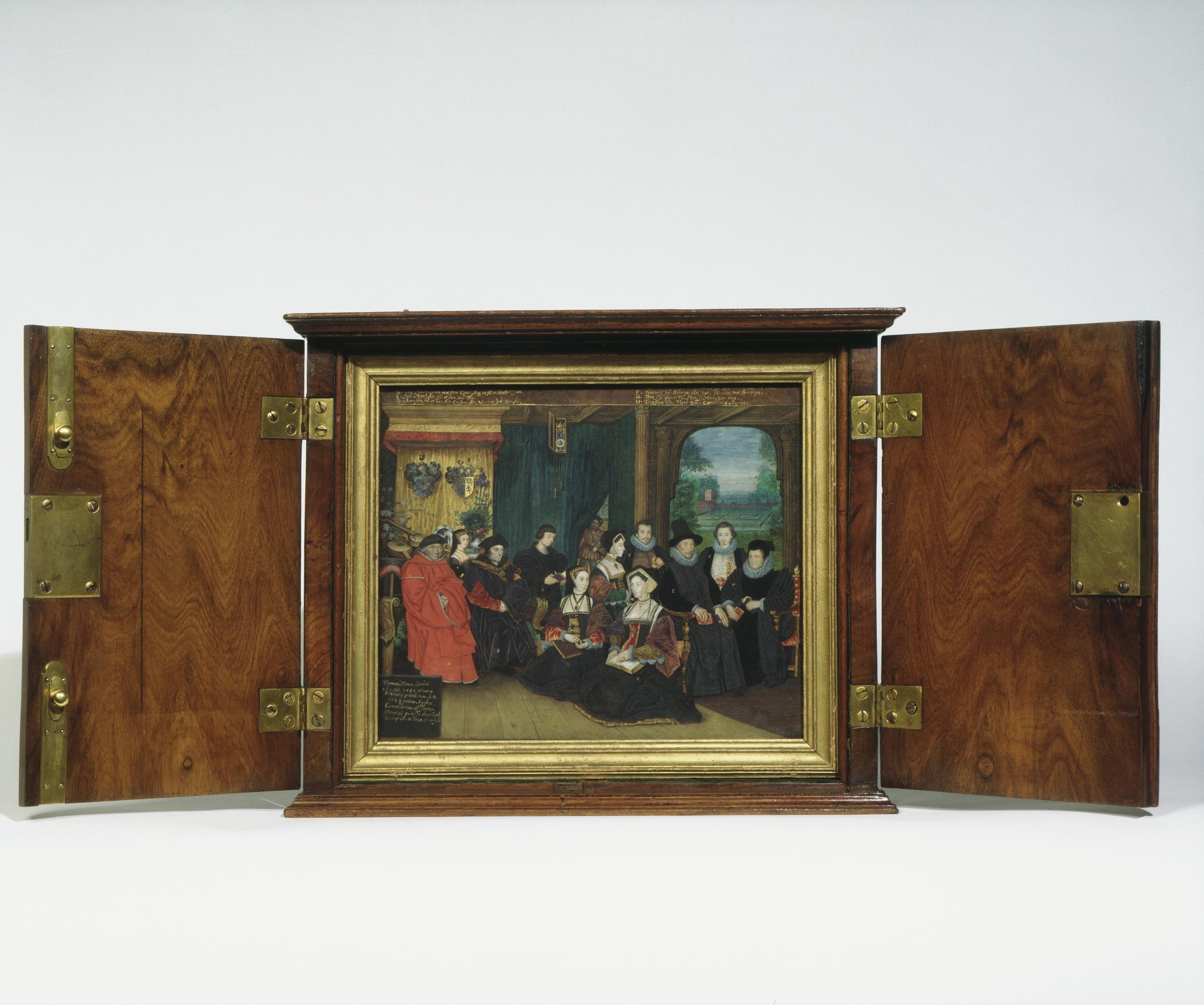
Here it is again, (scroll down to item 3 on the page). With it on this page you can see the sketch, item 2, by Holbein, on which it is based, and a related picture, item 1, which you can see better in my next link. This version is held at Nostell Priory in Yorkshire (National Trust).
And here is another related picture in the National Portrait Gallery, London.
First off, isn't it wonderful that
(a) these pictures have been handed down through the centuries, and not destroyed, by ignorance, malice or neglect.
(b) public-spirited people, into whose hands they came, bequeathed them to the nation - both the galleries acknowledge the name of the donor.
(c) they are available for us to look at in public galleries and at the National Trust.
(d) they are available for us to look at online.
Next, all the pictures are linked, by a fascinating conspiracy theory. This was originally aired by one Jack Leslau, (sadly, now deceased). It has regained currency as a consequence of the revival of interest in Richard III, after the discovery and conclusive proof of identity of his skeleton, followed by his stately reburial in March last year.
Of course, interest in Richard III has never gone away, largely due to the many mysteries surrounding his brief reign. The greatest is the mystery of what happened to the Princes in the Tower.
It would test your patience to read the full conspiracy theory here; if you wish, you can follow the link to Jack's own lengthy exposition. To sum up in a sentence, Jack believes that the Princes were kept safe in the home of Thomas More, and that the paintings offer clues to the discerning that prove this to be the case.
It's easy to get confused, but on this wonderful free site, the BBC, no less, shows you both the Lockey paintings right next to each other so that you can see the differences.
In essence, the second of them includes later generations of the More family, who could not all have been alive at the same time. It seems to be meant as a sort of family tree seen from the perspective of the 1590's. The first of the two, the painting Jack Leslau uses for his argument, only shows the members of the family as they would have been around the time Holbein made his sketch, ie about 1527. In his view, the young man standing holding a scroll on the far right is Richard, Duke of York, who disappeared aged 10 in 1483.
The young man is identified in the painting as John Harris, secretary to Thomas More. Leslau, however, believes that he is meant to represent John Clement, who married More's adopted daughter, Margaret Giggs, (the lady standing on the far left of the Nostell portrait) and was hence a member of the family. Although actually, says Leslau, he really wasn't John Clement at all, but Richard Plantagenet. So three layers of ambiguity. What is certain is that he doesn't appear in Holbein's original sketch. Can't argue with that. So there is a mystery there, although it may not be what is suggested.
It's also possible to pursue the link between Sir Thomas More and John Clement by looking at the first page of More's famous book, "Utopia". The first edition, published in Latin in 1518, has a woodcut of Thomas More, his friend Peter Gillis, the fictional character Hythloday, and John Clement on the title page. This can be seen here .
On the left is a picture of John Clement, indicated "Io Clemens". It's interesting to compare this image with that in the Holbein picture.
It's all a great testimony to the value of history, of documents and art, and permanence, and display. And the power of the imagination, to draw out links from tenuous observations, and draw conclusions.
It's all a great testimony to the value of history, of documents and art, and permanence, and display. And the power of the imagination, to draw out links from tenuous observations, and draw conclusions.
Subscribe to:
Posts (Atom)