Tuesday, 27 October 2015

Sleep Instructions

Many of my friends have problems sleeping.  One, who lives alone,  listens to the radio in the middle of the night, to drown out creaks and knocks in her home which frighten her.  Another suffers from restless legs and has to get up in the middle of the night to walk round the bedroom.  (Her husband is undisturbed!)

My own husband has maintained a sleep problem as long as I have known him.  Shortly after we met, he had to take some professional exams, and appalling insomnia plagued him throughout.  A few years later, when we were living in a small flat, he was asked to be best man for a close friend.  The stress of being in the limelight, and having to write and deliver a speech, caused him enormous discomfort.  He had to move into the sitting room and sleep on the floor for a week, in order to deal with his insomnia alone.

Insomnia is defined, for me, as that awful feeling that you have "been awake for hours" and will never sleep again, plus the plaguing worries that swoop in to the undefended mind in the small hours.

Recently, on a visit to a National Trust property, I realised for the first time that it may be entirely normal to be awake for a couple of hours in the middle of the night.

Here's the thing.


And going to bed early (I am mocked for retiring at 9.30pm), and "night time affrightments" are also entirely normal.

These are instructions to the lady of the manor's servant, but they could equally well be "note to self" in the twenty-first century!

Friday, 16 October 2015

Charles Morgan and his contemporaries

After discovering an interesting link to the period of the mid-1920's, a literary epoch which has long fascinated me, I post the following.

****************************************************

The Fountain, by Charles Morgan


This is a really peculiar book. It won the Hawthornden Prize in 1932.


Charles Morgan was more famous during his lifetime than after his demise. You can find a very brief biography on Wikipedia.

You may well ask, why did you read this book?

The connection derives from my interest in Vera Brittain. Charles Morgan was born in January 1894, a bare month after Vera, and is of the same generation in more ways than by mere accident of birthdate. Like Vera, he was a survivor of the First World War, and like Vera, permanently marked thereby.

Perhaps, like Vera, he would have forever remained a nonentity had it not been for the experiences of the First World War. And that Vera would have, is recorded in her own words, in a letter to her dear friend, Winifred Holtby, in which she decided that, her previous attempts at gaining recognition as a writer having failed, she would give her draft of "Testament of Youth" everything she had. If this failed, she recorded resignedly, "I shall remain silent." Fortunately, the book became an international best-seller, re-read and re-published regularly to this day.

Morgan's book "The Fountain", is not his first novel, but the first to gain important recognition. It draws heavily on his experience of being interned in Holland after capture in the early part of the War. Holland was neutral, and was not invaded, unlike the situation in which it found itself during WWII.

The Fountain does not appear in the book. Perhaps it is an allusion to sex. The book describes a rather spiritual love-affair, but the love-affair is absolutely not the heart of the book. The heart of the book is found in the search of the hero, Lewis Alison, for spiritual fulfilment.

It is impossible to imagine a book even finding a publisher, today, when the opening chapters are replete with such statements as:

"The struggle for some kind of stillness within oneself seems to run right through history........What I want is stillness of spirit....."

The common soldiery, to whom these statements are addressed, would, in today's parlance, be likely to utter imprecations such as "FFS!" if such words were to fall upon their ears.

Whilst shut up in the fortress in which he has been interned, Lewis welcomes the distance from his old life, (running a publishing business forced upon him by the early death of his father, the only means of support of his mother and sister). He looks upon the internment as a holiday, a time of complete peace and freedom from responsibilities, where he can write his book, which is to be "A history of the contemplative life."

After a time, the inmates of the fort are dispersed, and Lewis is placed in a castle, home of a Dutch aristocrat, which happens to be furnished with a magnificant library. The library is a place of seductive power, as well as great beauty, and much of the development of the love affair takes place in this setting.

The love affair itself, is completely incredible. There is no convincing description of how a person who would like most of all to become stiller and stiller until he enters a sort of hypnotic trance of introspection, embarks on a passionate affair. Indeed, as the affair approaches its physical consummation, the lover writes to his beloved a complicated analysis of love which he describes as "hypostasis" and their potential relationship as "a perdurable essence".

The library has a secret stairway to a tower, in which the "princess" sleeps, a tower to which the lover has secret access at night from the library. After a year or so of these nocturnal visitations, the girl's husband, a badly wounded German aristocrat, returns to the castle to convalesce. The affair is suspended, the war ends, the German husband finds out about the affair and dies, Alison is sent away by the girl's mother, to preserve the family honour. The ugly stepsister (who always knew, but found it impossible hitherto to tell about the affair) now finds it possible to tell all, so the girl runs away with a few jewels and a passport to join her lover and the book ends contemplating their embarkation on middle-class married life.

What did the contemporary literay scene find so enthralling, I wonder?

The beautiful girl, who is only 20, married far too young by her mother for social standing and to preserve a way of life, has no voice of her own. She is portrayed through the prism of men who find her beautiful: her stepfather, the Dutch baron, (who buys her jewels as a way of expressing affection) her lover's two interned friends, (who would do anything for her, so besotted are they by her beauty), her dying husband, (a very sympathetically drawn picture of a remnant of a now extinct German social class), who loves her and realizes that his love is not returned. What she saw in Alison is apparently his noble mind, and there is, conveniently, no accidental pregnancy to worry about. None of this is realistic to a full-blooded married woman of the late twentieth century and the new millenium.

I can only conclude that the book is the expression of a dying class system and that the people who read at all in the early thirties, who would have been the remnants of the dying upper middle class before it faced the final onslought of WWII, recognized themselves. And of course, that did not include women, who still had little or no voice in public life at the time. Vera Brittain's book was published the following year, 1933.

**********************************************************************

Other writers who were active during this time and all knew each other and referred to each other in their letters and autobiographies include:

Winifred Holtby
Storm Jameson
Phyllis Bentley
May Sinclair
Rose Macaulay


I have books by all these ladies on my shelves.  All were born within the same ten years (1888 to 1898).  All were indelibly marked by the First World War.  Three  of them saw active service in that war (although poor May Sinclair was shipped home from Belgium almost immediately as being completely unsuitable, even as an ambulance driver).

All the five listed above remained single, although Rose Macaulay had in interesting 25-year affair with an unfrocked, married Catholic priest.  All their lives were fascinating.

I will post more in due course.


Sunday, 11 October 2015

A Great Love

Here's what wrung my heart, and nearly brought me to my knees:


My Bookcase

Now no longer mine.  I remember the day we first brought it home  - like bringing home a new baby. It was for my personal use.  This was thirty five years ago.  We had just bought an old stone house in a deeply unfashionable suburb of Leeds, and wanted some antique furniture to put in it.

We then moved to a brand-new house, and although the bookcase did not fit the period, we kept it, as most of our furniture consisted of ancient hand-me-downs anyway.  Over the next thirty years, the hand-me-downs went, one by one, and finally, the house now being decorated and furnished in contemporary styles,  my husband got rid of the bookcase.

He sent it to be stripped, according to the advice given by a Laura Ashley design consultant who visited the house, and it never came back inside.  This would have required it being reassembled, which I waited patiently for him to do, eventually realising that he had no intention of so doing.

It languished in the garage for five years, miraculously avoiding ruination by damp (my husband is not totally heartless - he carefully wrapped all the dismantled parts up in bubble-wrap). 

Then our younger daughter acquired, within the space of a year, a serious boyfriend and a Victorian house.  The boyfriend is full of energy and totally practical - he owns a sanding machine, and can fix shelves.  I ventured to suggest, cautiously, emphasising that there was no obligation, that they might like the bookcase as it would fit their décor and period home rather well.

They agreed!  The boyfriend's extensive contacts book included a removal man who would take the dismantled parts, (free), from the East Midlands to the Sussex coast, in an empty van intended for the return journey.

The boyfriend put it all together again, bought some new dowelling to put the internal shelves back up, and sanded the whole thing smooth.  The stripping process had left it a bit raw.

When we visited in September , and I saw my bookcase standing proudly in their sitting room, full of their books, I nearly cried.  It was a moment of strong emotion.  I wanted it back, of course.  And looking at it there brought back so many memories, of the various stages it had gone through in our lives.  A repository for professional study materials, a children's toy cupboard, a place for storing sewing materials.  As well as a bookcase of course.

I was so pleased it had found a loving home, a place where it is appreciated and cared for.  Secretly I hope that a new generation will use it as a toy cupboard again.  I haven't uttered a word, of course.


Tuesday, 22 September 2015

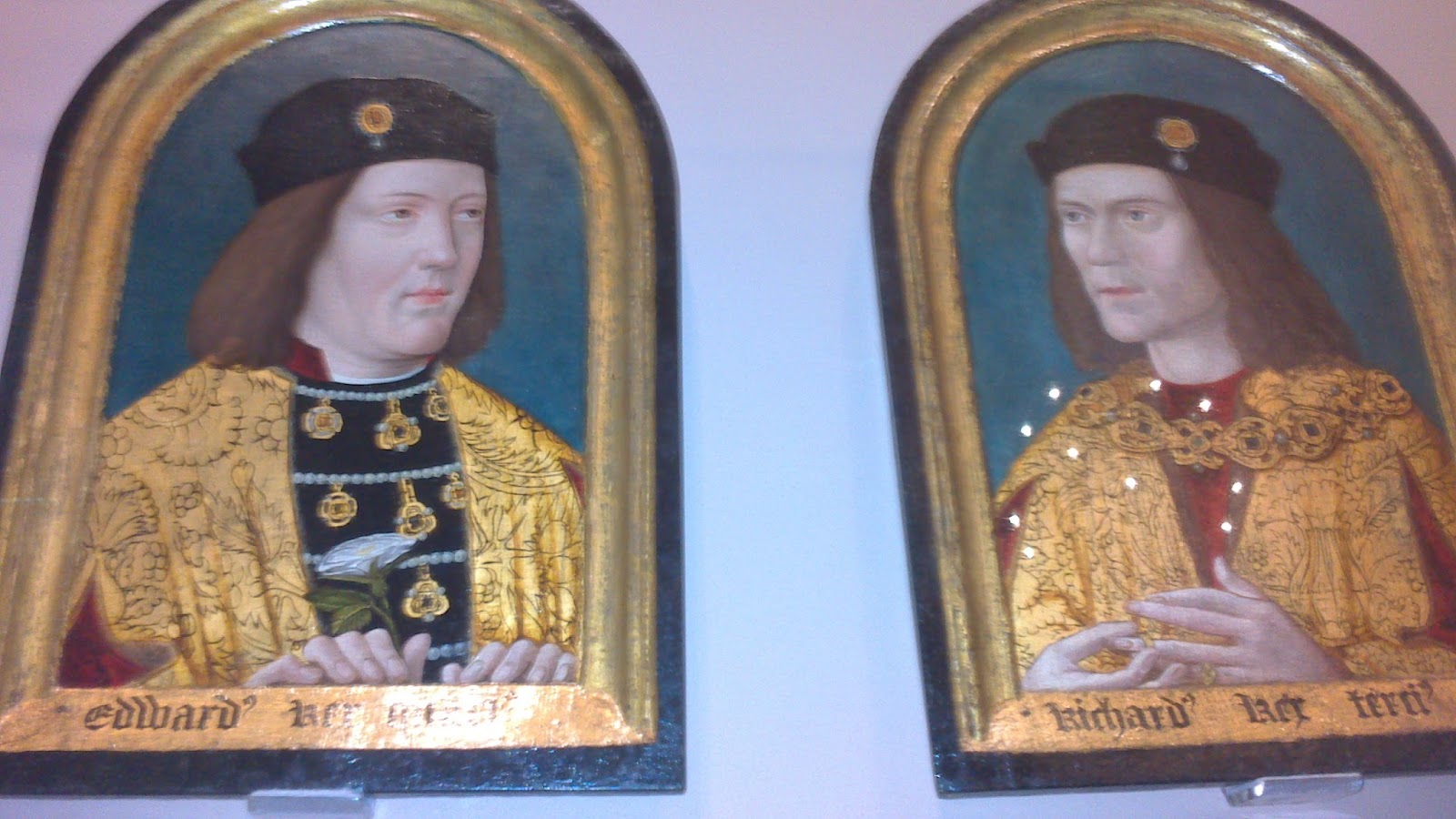
The Society of Antiquaries, London


King Edward IV and King Richard III Matching "Arch" Portraits


Here's where I went today, to attend a free public lecture by John Ashdown Hill.  What an immense privilege.

I already have two of his books on my Kindle.

 Eleanor the Secret Queen,

and

The Last Days of Richard lll and the fate of his DNA.

This lecture gave the kernel of his new work, "The Dublin King" and was a fascinating and concise indication of all the relevant points about who the "Dublin King" really was.  Very persuasive.

I don't know how the man's able to sleep at night, with all that research and delving into hitherto undisturbed archives, swimming about in his head.  He is already at work on two further books, one for next year called "The Wars of the Roses" and one for the year after, about Edward IV.

Curiously, he doesn't seem interested in Perkin Warbeck.

Still, it was a great British day out.  Free education, history, the conservation of the past.  All wonderful.

And the two pictures above were hanging on the wall right above my head.  You can see all the Society's picture collection online, but nothing beats the real thing.

Thursday, 10 September 2015

Balance

This year, my first full year in retirement, I have decided to do some things differently.  I posted yesterday about pushing the boundaries of my comfort zone regarding sleep.

I felt that I should move out of my comfort zone in other respects.  My normal spheres of activity consist of sitting, preferably at a desk, and using my brain.

I love sitting.  Yesterday I even sat to do some deadheading, carting a kitchen stool around the garden with me.

I've never been a great one for using my hands, athough I have the greatest respect for people who do.  And I've certainly had plenty of chances to see them in action recently.  We've had a constant stream of
workmen processing through the house for the last three months.  Builders, fitters, electricians, floor-layers, plasterers. They have taken out walls, doors, floors and ceilings.  Then re-bricking, re-plastering, and breaking things inadvertently, thus causing more workmen to come. I admire their energy and zeal for getting their hands dirty and lifting heavy weights, but could never, even in my younger days, have hoped to do any such thing.

In my career, I sat at a desk and pondered over intellectual problems.  I was required to read a lot (albeit company law and tax regulations, largely), and write reports, memos and minutes.

I have also been doing a lot of reading since retirement, so when thinking about the U3A, I felt the need to join a different group.  Steer clear of my comfort zones, which are sitting, reading and writing.  Such opportunities exist, in that there are several reading groups and four creative writing groups in my locality.

In the interests of pushing myself and striking a balance, I decided on Yoga.

Thirty-five years ago, I joined a yoga evening class, and all I can remember of it is that I couldn't do any of the poses.  I also remember being so relaxed in the lying on the floor part that I fell asleep.

I explained to the leader of the U3A Yoga class, when discussing my proposed visit for a trial session, that I had been spectacularly useless at my previous attempt.  "I just lay on the floor doing the breathing," I said. I didn't mention the falling asleep.

She was completely non-judgemental, and yesterday I went along for the first session of the new term.

We spent nearly the whole session just lying on the floor doing the breathing (great! I can do that!) And I didn't fall asleep!  Maybe that was because it was morning, not eight-o'clock at night after a full day's work.  We then moved on to The Warrior Pose.

It looks simple, but try it.   I wobbled, and thought I would fall over, despite having both feet on the ground.  "Good," I thought.  If I think I'm going to fall over, this means I need to do this, and I need to improve.  So, good for pushing boundaries, and good for balance, all round.

I didn't ache this morning, or feel stiff.  I recognized two people I knew slightly at the class, so had  a nice chat.  Sociable, then, as well as stretching. 

Hope I can keep it up!


Tuesday, 8 September 2015

Royal Shakespeare Company, Cycle of 4 Kings

Gulp!  I have just booked the RSC Cycle of Kings for January 2016. 

This is way out of my comfort zone.  I need to go to bed at 9.30 every night just to function normally.  I haven't been out at night for years, and I even missed seeing the RSC's "Bring Up the Bodies" as an adjunct to "Wolf Hall" because I resisted booking an evening performance.

Two evening performances one after the other, with a matinee in between, is really going to challenge me.

I must challenge myself, however.  And since I am now retired, I needn't worry about falling asleep at my desk the following week.  (Which used to happen, even when I hadn't been to the theatre the night before).

I could not resist the idea of seeing, in the correct historical order,

Richard II
Henry IV Part One
Henry IV Part Two
Henry V.

David Tennant will be playing Richard II.  Alex Hassell, whom I saw as Biff in "Death of a Salesman" at Stratford earlier this year, will be Henry V.  And Antony Sher, who played the title role, Willy Loman, in "Death of a Salesman", will be Falstaff.  If I can keep awake, it will be awesome.

Antony Sher has even written a book about playing Falstaff.

I'm excited!


Sunday, 16 August 2015

Old English Wisdom


The North Elmham Rood Screen - a man riding a pig. The carving dates from, it is thought, the fifteenth century, but the sentiment is Anglo-Saxon, according to "A Clerk Of Oxford" who writes about Old English sayings here.  (It's number ten on the list).


"It’s up to the pig now, said the man sat on the boar’s back".

It's interesting to think of this pre-conquest salty wisdom, being passed down in a remote, extremely rural setting, via generations of country-folk. The carving has survived all that has been thrown at it, and we can see it today much as it was when first set up. 

Those short, pithy utterances have a deep earthy humour to them, which tickles me.