Wednesday, 27 December 2023

Christmas Again


Picture shows a typical dining table scene from previous years.

Alcohol and pyrotechnics


 As this is my private blog, and my husband will never see it, I share here my thoughts on our 45th Christmas since we became a couple.

We spent the day with our elder daughter. She cooked a roast chicken, (no turkey, stuffing, bread sauce, cranberry sauce, sprouts or stewed apple, all of which used to accompany the main course in our Yorkshire dominated household from days gone by).

I have never liked turkey, in fact I grew to loath it over the years. We did give up with the stewed apple quite early on, it was a relic of hub's grandmother, and the bread sauce was eased out too over the years. To be replaced, unfortunately, with celeriac and mashed potato mix (with garlic infused milk).

This year, at our daughter's, no alcohol was served at all with the meal or at any other time of the day.  Our daughter did not serve a Christmas pudding, or any other pudding other than one chocolate each after the meal.

This was the happiest Christmas I can ever remember in all my 70 years.

No one sulked in the afternoon, no one upset anyone else, and there were no arguments about anything.

I have put up with my husband's total domination of Christmas for the last 38 years.  First we had to go to his mother's, until his grandmother died, at 96.  Then his parents and sister came to us for the next 33 years. After his mother died, at 97, we stopped hosting and have spent the last two years at our daughters'. Our younger daughter hosted last year and did a roast ham buffet (well done, don't be a slave to tradition, I said). This year our elder hosted but not the whole family party of nine or ten adults, just husband and me.  

Again, a wonderful refreshing break with the obsessive tradition that EVERYONE must all be crammed in together for the 25th of December. Which, as I said, I put up with for 38 years, 33 of them hosting at our house. 

I was never asked, what would you like to do this year, it's your turn to choose. When his parents etc came, they always came for a full week, until I put my foot down and said they had to go after three days.  Every year we had an argument about whether they could stay for three days or four.

Alcohol was served every day with the main meal, which after a very long time (too long) I realised was making me feel tired, irritable and bad-tempered.  

On the big day itself, my husband always insisted on serving champagne at the start, on empty stomachs, and then opening a second bottle at the table as well as serving wine. There were arguments every year about the second bottle of champagne.

Every year, my husband made a huge performance of getting the camping gas stove out of the garage to heat brandy at the table and pour it over the Christmas pudding then setting fire to it. Everyone dutifully oohed and aahed and clapped.  He thought this was the star piece of the whole show.

This year he was prevented from showing off in this way because there was no Christmas pudding in our daughter's house. (Had there been one, he would have tried to get his own way, even just heating the brandy up in a saucepan on the hob).

Oh my god, how has our marriage lasted this long.  No wonder the solicitors' offices are full of people seeking a divorce in January.

Wonderful daughters, doing it their way (our younger just decided they wanted to have Christmas day in their own home this year, and would not be travelling anywhere).

Thank you God, for this lovely Christmas.


Sunday, 3 September 2023

An Uneasy Inheritance My Family and Other Radicals by Polly Toynbee, published June 2023


I wanted to read the book as I am interested in the author's father, Philip Toynbee and recently tracked down a copy of his book "Friends Apart" (published 1954) about Esmond Romilly and Jasper Ridley. 


Above is an extract from "Friends Apart" - a  description of Esmond Romilly as he appeared when Philip Toynbee first encountered him. Philip, eighteen, ran away from Rugby (his private school)  to join Esmond, then fifteen, who had run away from his private school, Wellington. Philip's account is hilarious - vivid, self-deprecating, emotional and entirely without subtext or ulterior motive.  (Other than, very subtley, to point out his own inadequacy by comparison.)

Polly, who quotes much of this in her book, manages to transform it into a rather dull and pedestrian account of some boyish leftists who had the very highest leftwing political ideals even though they had been born into upper-middle-class families and had been privately educated.

Her whole book is about being the descendant of upper-middle-class families and the advantages this confers. For every mention of these class antecedents she then has to justify herself by saying that she is and always has been "on the left" and so were her ancestors, and so they are much better than everyone else.  This seems to be the message of the book, that being upper-middle-class is to be better than anyone else (why else would she be so careful to keep on emphasising her semi-noble ancestors), and that being on the left is being better than anyone else.  Double winner, Polly!  


In Polly's book, Esmond features because of being the nephew (some say illegitimate son) of Winston Churchill and was married to the aristocratic Jessica Mitford.  Polly makes sure to include the information that Jessica Mitford was Polly's godmother.  Jasper doesn't get a look in as he was not aristocratic or related to anyone famous. 

Polly is a frightful snob.  She is careful to list all her aristocratic ancestors in full detail. The ones who are not aristocratic (who went bankrupt for example - at least two of them) or were otherwise insignificant, are hardly given a paragraph.


I am a few years younger than the author, and used to read the Guardian in the years when she was a womens' page  columnist, but didn't take to her. I found her sanctimonious "leftism" and patronising tone boring and soon stopped reading her columns. I did note that her byline photo remained the same for years, always making her look much younger than she was. The photograph beamed out from the Guardian for years and years showed her character in her expression - a smug simper.  Here is pretty little Polly - a blonde (not a natural one, as photos from this memoir show), used to charming people and getting her own way.

I've always thought that anyone who still calls themselves Polly in their sixties and seventies is hankering after their lost childhood - and lo and behold, it turns out that she was christened Mary Louisa - but hung on to her pretty childhood nickname throughout her life.

I later found that my longstanding impression that she remained, at heart, a silly, spoilt little girl, has not been altered by reading this memoir. If anything, the memoir has confirmed it.

I thought I would find her trademark smugness and complacency irritating, and so it proved.  I almost snapped the book shut and almost flung it aside in the early chapters, so boring was it to keep on reading about how superior it is to be "on the left" even if you have a holiday home in Italy and a multi-million pound house in London. She admits on Twitter (2012) to the holiday home in Italy but denies that it was in Tuscany and says she has it no longer. 

In the last chapter of the memoir, however, she admits to having a holiday home in Sussex.  So much for her leftist rants in the Guardian about middle-class property owners hoarding property that should be let to the poor.  Camels and eyes of needles kept on coming to mind as I read on.  She smugly admits to failing her 11-plus, then being rescued by her parents sending her to a private school - not for her the run-down secondary modern.  She admits she paid for private school for two of her four children - this is typical leftie "Do as I say, not as I do" behaviour.  Harriet Harman, who campaigned via her position as a grandee of the Labour Party for the abolition of Grammar Schools, chose to send her son to one. Because, presumably, she wanted the advantages this would confer for her own child, while denying them to others. Diane Abbott's choice to send her son to the fee-paying top private City of London School is more understandable - being the black son of a black single mother (albeit a member of the Shadow Cabinet) represents a hurdle one would want to overcome if one had the means, ideals or no ideals.

One of the deep failures of logic in this line of thinking  is that she assumes everyone would want to be a journalist or a doctor or a lawyer. It is therefore so unfair that these careers are reserved for scions of the upper middle-classes. Well, Polly dear, you are wrong. Not everyone wants to be a journalist, doctor or lawyer. I have met many very happy and fulfilled plumbers, decorators, electricians and carpenters in my lifetime. Conversely I have met several doctors who complain of unbelievable levels of overwork, and lawyers who, while not actually complaining, (they are very well paid, after all), look drained and exhausted and struggle to have any family life. Polly's flawed (and self-centred) logic is that because she has enjoyed her career, everyone else would love to have the same.

I've also met poorly paid journalists, who, while they like their job, don't recommend it any more than they would recommend acting as a career - both represent a chimera of apparent fame, but actually shallow celebrity that is soon forgotten.

I kept going in the hope of reading more about her father Philip, her grandfather Arnold Toynbee, and other famous (in their day) eccentrics. This was what I found reasonably interesting in the book. 

These eccentric middle-class and upper middle-class intellectuals remind me of the Knox brothers.

Their relative Penelope Fitzgerald (nee Knox) wrote a superbly witty, detailed and empathetic account of these four (her father and three uncles.)  Apart from their intense interest in literature and religion, the extraordinary eccentricity of the four Knox brothers is their most outstanding characteristic. In fact, intensely intelligent people often come across as eccentric, I think. The author captures, in dry, succinct prose, their loveable awkwardness and their fondness for each other in a close-knit family. She relates what are obviously family anecdotes which are sometimes laugh-out-loud funny. The similarity to Philip Toynbee (highly eccentric, highly intelligent, and a superbly witty writer) is notable.  Philip Toynbee even became interested in religion later in life, despite his initial communist atheism. 

The Knox Brothers is a far more entertaining and informative book than Polly's.  That's because Polly can't stop interjecting moral lessons throughout about leftism.  Penelope just presents the lovable and endearing old boys as they were, Polly always wants to point out a lesson.


The lesson hammered out over and over is that leftism is right and everyone else is wrong. On many occasions she just states this categorically, without any self-awareness. Everyone else is wrong. She never questions this, never wonders why (in her own words) the Tories have been in power for two-thirds of her lifetime. She infers that it is because the electorate are stupid or believe lies. Or the electoral system is rigged. It never occurs to her that the Tories are elected because a democratic system of one person one vote shows that the larger mass of the British people broadly agree with them. 


The overall tone-deaf obsession becomes more and more boring, leavened slightly by the interesting family photographs and vignettes of her elder sister Josephine, and other tragic figures from her family.


I was glad to finish this book, and returned to "Friends Apart" with renewed interest - her father's prose certainly sings, and is laugh-out-loud funny in places. It has no dictatorial moral asides throughout, unlike his daughter's. 


Monday, 22 May 2023

The Death of Martin Amis

 Martin Amis, enfant terrible, described as the literary "Mick Jagger" has died at the age of 73. 

A shock - he seems too young (and only four years older than me).

I've commented on him in passing in two posts hitherto (see labels), in which I noted that although I had read some of his non-fiction, I had never read any of his novels.  This situation has not changed.  Now I think it never will.  If reading a serious novel is a dialogue with the author, there is no need for this dialogue now. (I'm not including entertainment novels in this generalisation, and most novels I read are for entertainment only).

So, goodbye, Martin.  Golden, good-looking boy, famous son of a famous father, acclaimed and praised voice of an era.

"Golden girls and boys all must

As chimney sweepers come to dust"  (Shakespeare, Cymbeline).  

I've realised that this is why I find planting trees more important (see previous post).  They will outlive me. (And most writing other than Jane Austen and Shakespeare).


You can measure an oak tree's circumference with a tape measure and refer to an app to see how old the tree is.  This one is approximately 350 years old.


Tuesday, 16 May 2023

Reflections Inspired by Thomas Hardy


This picture shows a house in Sturminster Newton, Dorset, where Thomas Hardy lived with his first wife Emma for two year from 1875.  They had been married just five years and were still very happy.  He wrote a poem about it called "The Two-Year Idyll".  His diary extracts from this period suggest that the maid they had at the time might have inspired his famous novel "Tess of the Durbervilles".  The maid was seduced, left their employ by climbing out of a window at night (the same window through which her seducer entered), had a baby which died, and then disappeared.


I've visited Thomas Hardy's birthplace at least three times, and the house where he died likewise.  They are both now owned and managed by the National Trust, and are filled with tasteful period artefacts (none of them original to Thomas Hardy).  This is the first time I have managed to track down Sturminster Newton and it has been on my "list" for about 10 years.

As a first wife myself, once much appreciated, but in old age resented and ignored, I had enormous sympathy for poor Emma.  Once adored, then neglected and despised, her story struck me as tragic but probably fairly typical. As Mrs Charles Dickens wrote in a letter " I was loved once."  Mrs Dickens, just a few years ahead of Emma in age and experience, was cast aside for a mistress, made to leave the family home, and forcibly separated from her children.  

Emma and Thomas had no children.  A diary entry from the Sturminster Newton interlude suggests that this was a source of sorrow to Thomas ... "Not a sign of one for us". 

A recently published book called "The Chosen", was shortlisted for the Walter Scott Prize for Historical Fiction 2023. https://www.walterscottprize.co.uk/seven-strong-shortlist-announced-for-2023-walter-scott-prize/

This novel imagines the relationship between Thomas and Emma and how it deteriorated in the final years (Hardy's mistress Florence Dugdale was actually invited to the house and spent a Christmas with them).  I thought it was very well written, and well imagined except for one thing - Emma blames Thomas for the fact they never had children whereas his actual diary entry suggests otherwise.

It's well worth a read as an insight into their marriage.  I recommend it if you don't have time to read his diary, her "Recollections", their letters, and his awe-inspiring poetry.  After Emma's death he realised what he was missing and poured out a torrent of poetry re-creating their romantic meeting in Cornwall, their four-year courtship. Significantly, perhaps, he wrote nothing about their wedding, and not a word about their  honeymoon.  

I finally tracked down the house, and the porch where Emma used to wait for him in a white muslin dress at the end of a long, lonely day with no friends and virtually nothing to do. He immortalised this vision in a poem.


"..The dusky house that stood apart,  
And her white-muslined,waiting there 
In the porch with high-expectant heart..." 


The porch above is unlikely to be the original, as porches especially wooden ones have a short life. However, the position is the original one, and it is amazing that there are no new houses built up around this pair of semi-detached villas. Emma,dressed in white muslin, as she was not expected to do housework, was very lonely, waiting for her husband's return, and he knew this, as his poem shows.


 Guilty, but not enough to stop him doing so, he admitted that he dawdled on the way home, knowing that she was lonely and eager to see him.  He spent time looking at the river, and lingered on his walk over these meadows, which are virtually unchanged in 150 years.

We walked across this meadow, as he would have done.

I had thought that I would be overcome with emotion at finding myself at last treading in the footsteps of Thomas and Emma, and re-creating the feelings he wrote about.  He was actually quite good at imagining how Emma must have felt, after she was dead and it was too late.

This did not happen, however.  I was pleased to have ticked the visit off my list, took the above three photos, and then went off to find a pub for lunch.  I realised that something has changed.


 For those who wonder if I'm still here - having posted nothing for nearly a year.

Yes, I'm still here. About to celebrate my 70th birthday this month.  

The pandemic changed a lot of things in my life - some things have never recovered - my relationship with books has changed. After the compulsive reading and listening to audio books which spread over the two years 2020 to 2022, it no longer seems so vital to engage with other people's versions of the world.  My own, rapidly running towards its conclusion, seems far more important.

I no longer volunteer, since the pandemic closed all the outlets in which I did so - the museum, the local historic monument (English Heritage), plus a nearby National Trust venue.  I have not returned to volunteering, being that much older, being less mobile and active since two falls - one in 2021, one in 2022.

My mother-in-law died (unrelated to Covid). The last member of the older generation, and leaving a big gap in many people's lives. The world seems a little emptier, and it has definitely affected husband's outlook on life, not for the better.

I'm still reconfiguring, and trying to come to terms with the finite nature of existence, which didn't seem so finite whilst mother-in-law was still going strong at 97.

I still keep a record of every book I read, and every audio-book I listen to, but it doesn't seem to be so important to share.  Planting trees seems much more important.


Best wishes to those who have enquired, why not let me know how your views on life have changed, or not changed, since the events of the last few years.


Tuesday, 9 August 2022

To Paradise, by Hanya Yanagihara


I've now read this book, by an author  referred to in the previous post, in which I reported on an interview  found in "The New Yorker."


It's extremely rare that I turn back to the beginning to read again any book I have just completed.  The last time it happened was with Hilary Mantel's personal memoir, "Giving Up The Ghost".


"To Paradise" is long, and divided into three sections - 1892, 1992, and 2092.  The sections are connected by what appear to be members of two or three families, the Binghams, the Griffiths, and the Bishops.  Characters from the first section turn out to be the grandparents and great-grandparents, and later the great-great grandparents of those who appear in the later sections.


Another common theme is that all the main characters are gay men, and in fact, the writer depicts these sometimes successful, sometimes failed relationships with such skill, delicacy and empathy that I had to look the author up again to make sure that it is not a man.  I'm not sure why this is such an important theme, as the successes and (more often) failures are similar to those of any relationship.  There is also the common theme of discrimination, which runs throughout the novel.The main characters in each section are discriminated against, usually on grounds of their sexuality, but also on racial grounds and even on the grounds of their political and social position.


The theme of the total destruction of the world as we know it is what hits hardest. As our homes sizzled in hitherto unheard of 40 degree temperatures, I was reading of environments devoid of trees - they had wilted to death in constant and relentless heat. As we were warned of hosepipe bans, I read of water shortages such that showering took place in communal "air showers" and even these were strictly rationed.  News footage of wildfires accompanied me as I read of the exhaustion of the emergency services  dealing with fires following hard on the heels of devastating floods.

The recent pandemic of Co-vid 19 (which is not over yet) runs through the book - a relentless series of pandemic waves pouring over the world in all too realistic detail.  The great skill of a good dystopian novel is to select actual, factual elements from the world around us, then weave them into a narrative of imagined characters set against recognizable backdrops. The backdrops are altered just enough to make the settings scary and the events are exaggerated just enough to convince the reader that this could be us, if things should, (as the narrative insists that they will ) get  worse.  


It's possible to trace the apocalyptic climaxes in the third section back to events and human activities from the first and second parts.  The middle section is particularly vivid in its depiction of the island of Hawaii, notable for desecration by human activity.  The words of a Joni Mitchell song rang in my ears throughout - "They paved paradise, and put up a car park."

The first time I read the book, I concluded that the "Paradise" of the title was death.  Some of the main characters actively wish for death, others can only achieve peace via death. And the mess humans have made of the planet seems a fitting reason why death is the only solution for human beings.  

Near the end, we are given an ancient fable about a lizard which ate and ate and ate every leaf, blade of grass, fruit, fish,  anything it could, because it had to eat to stay alive.  Its whole purpose was simply to eat and stay alive.  Naturally it ended up destroying its habitat until there was nothing left to eat.  Ah, we think, a perfect image for the human race, destroying its environment - then humans will die out completely and that will be the end of it.  But the lizard doesn't die, it returns, as a creature walking upright, and the environment gradually regenerates.  The narrator in this section reflects that some will die, but others will "keep doing what we always have ... doing what our nature compels us to ..."

The second reading made me think the complete opposite.   Life is an ongoing gift, which we should never reject by pessimism and defeatism. The majority of us will not in any case choose to reject, but are driven on by the impulse to survive.

Life is the paradise, the world is the paradise.  It's up to us to make the best of it.  


Friday, 21 January 2022

The New Yorker, January 17th 2022

I am a great fan of the public library system, and have written here about my first library book, which I "borrowed" (in fact my mother handled the entire transaction) at the age of five.

And here about the efforts of the public library to interest me in e-books.  My scorn, expressed ten years ago, has been replaced by delight, especially since the pandemic when the public library buildings were closed for months on end. Many wonderful books could be accessed, at the touch of a phone screen, and audiobooks could be downloaded free of charge. I have written here about the many audiobooks I listened to last year, and every single one was a free download from one of two library websites. One is called "Borrowbox" and the other is called "Libby".

A further delight offered by the library Libby app is the unlimited quantity of magazines available to read online. Downloading a magazine does not affect the number of books or audiobooks you are allowed to borrow at any one time.

You can read the Radio Times, (this does require some patience in scrolling, as the pages are so full of tiny boxes).  You can read "Hello" (if you want to catch up with the latest pictures of William and Kate). You can read "The New Yorker".  

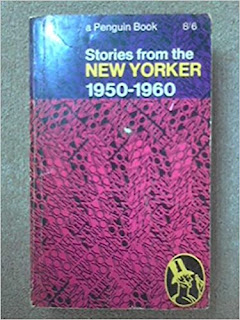
Now, I spent much of my youth reading stories from The New Yorker, anthologised (my copy is shown below)


in paperback form. I still have a copy of this book, in this exact edition, increasingly fragile and yellowing, as it dates back 60 years. My ideal short story, as showcased in this collection,  is encapsulated by a conversational ambience, a comfortable feeling of fireside chat, a homely, yet educated tone, (one often emerging from an older, immigrant, poverty-soaked childhood), an emphasis on family, childhood memories, and family relationships.

When I read the complete edition of Sylvia Path's letters, I was intrigued to note that one of her great ambitions was to have a story published in The New Yorker.  The magazine accepted many of her poems, but her ambition for a story was not realised.  This was comforting to me. When a writer has become a legend, it is sometimes hard to imagine that they ever failed at anything.  This brings Sylvia to life as an ordinary human being, a new perspective.

So when I discovered that I was able to access every weekly edition of the magazine online, free, and peruse at my leisure, I was delighted.  I homed in first on the stories. Stories these days encompass every type, every background, every type of voice. Some of them I just can't find interesting.  

At other times, the story is pure genius, which is hard to define.  An example is anything by the Chinese born scientist, Yiyun Li. Here is a novel which I strongly recommend, as a good indication of her political depth, historical knowledge, and emotional intensity. You can also listen to an episode of BBC World Book Club here, in which she talks about this novel.  Yiyun Li was born in China, so brings a very different background to the table, also being a scientist she is not the usual type of writer. 

Many stories in The New Yorker, however, appear to me to be both pointless and boring.  If nothing happens, I struggle to see why the story is deemed to be worthy of publication.

I am an eternal seeker after the next interesting story, so I persist.  This week I am reading the magazine edition of 17th January, and have devoured the first of my chosen items of interest, an interview with the New York based writer, Hanya Yanagihara. 

As a subscriber to "Goodreads" and "Guardian Books" website newsletters, I have already come across this author's name as one to look out for on lists of the best books to be published in 2022. Her new book is called "To Paradise." 

She is best known for her second published book, which appeared in 2015, called "A Little Life".  I have owned a copy of "A Little life" for some years now, and have yet to read a page of it.  The fact that it is 700 pages long is of less importance than the reviews, which all emphasise the content as being terribly upsetting, largely about appalling physical torture and abuse. This has put me off.  The new book, following three timelines, 1892, 1992, and 2092, in New York, sounds interesting, so I read the interview.

As is sometimes the case, I found the author herself (as portrayed in the interview) far more intriguing than the book itself.

She spent fifteen years writing her first book, "People Who Live in Trees"which seems like an incredible marathon.  A triumph of self-belief. It was little thought of at the time, and was quickly completely overshadowed by her second, "A Little Life".

She spent 18 months writing this, her second book, a 1,000 page long manuscript, writing between nine and midnight every evening, and through the weekend.

She lives in an apartment containing 10,000 books. She is 48. 


Why do the numbers grip me more than the content? I am not sure.  All I can say is that I find her own life, as viewed and interpreted by the New Yorker interviewer, far more fascinating than the idea of reading a lengthy tome about torture and abuse, however well reviewed.  I went to my upstairs bookcase and brought down my copy of "A Little Life" to my downstairs bookcase, in case I should feel the need to dip into it.  I haven't felt this need yet.

I think what I really find fascinating is how diverse writers are, how their lives are so different from mine, how they scintillate with visions which they translate into words.  Some of these word-pictures I find entrancing, some moderately interesting  and some completely boring.  But the individuals themselves, the writers, each one completely an entirely unique human being - now THAT is interesting.


Friday, 7 January 2022

The White Ship and In the Midst of Winter

 Two More Books finished, and still in the first week of the New Year! Awesome progress.

This one is  history book, set in the reign of Henry I, but reads like a very exciting blockbuster.

There are some great female characters in the history too, almost all of them called Matilda.

Matilda, wife of William the Conqueror, is the mother of Henry I, who was her youngest son.  She had nine children, four of them sons.  Two died in hunting accidents. One of these was the second son, Richard, the other the third son, William II of England. The third and fourth sons became William II and Henry I.

Robert Curthose - short trousers - (the eldest son) tried to become King of England, as one might expect, him being the eldest.  However, the Norman rules of succession were slightly different, and so it was accepted when the Conqueror's third son, William Rufus, succeeded as King of England.  After causing a lot of trouble in Normandy (where he was the legitimate heir under Norman rules of succession), Robert was finally captured and imprisoned by Henry I and kept imprisoned for the rest of his exceptionally long life.
 
The next Matilda was the first wife of Henry I - she was previously called Edith but renamed after marriage because Edith was an Anglo-Saxon name. 

A third was Matilda of Anjou, betrothed to Henry I's only legitimate son, (on whom the plot turns) - he was drowned in the White Ship in 1120, thus leaving Henry without an heir.  The kingdom was plunged into anarchy, literally, "The Anarchy" as it was referred to by contemporary historians, following the death of Henry I.  

A fourth Matilda, "the Empress"(a title gained on her first marriage to Henry V  of Germany), was the daughter of Henry I. She was his only other legitimate child (he had 22 illegitimate ones). She was named his heir and he intended her to inherit, but as she was a woman, her cousin Stephen took the throne instead, supported by the nobles who didn't want a woman on the throne.  Stephen, a likeable but weak character, was married to yet another Matilda, the fifth in this list. She was a strong and interesting woman, without whose support Stephen's reign would have ended much earlier than it did.

I feel that the field is wide open for a wonderful historical novel, possibly called "The Two Matildas", in which Henry's daughter and his nephew's wife battle it out over the next fifteen years after Henry's death.

I followed "The White Ship" as an audio book, which is a great way to consume more works while multi-tasking. 

A fascinating interview with the author, Charles Spencer (famously brother of Princess Diana), is available FREE.  You do have to log in and register, but after that, it's all free.

My next book is as follows:
I studiously avoided Isabel Allende for most of my life, having noted that her blockbuster "The House of the Spirits" seemed to be about things that wouldn't interest me.  I did watch a rerun on TV of the film, and found it better than I expected.  I remained a bit snobbish about blockbusters however, for some further years.

The real breakthrough came when I picked up a copy of her autobiographical work "Paula" in a charity shop. It's about the sad illness and death (at 29) of her beautiful, clever, successful and much adored only daughter, combined with a history of her own life intertwined with the twentieth century history of Chile, Allende's birthplace.  
After this, I would read anything by this author (always excepting The House of the Spirits).  

"In the Midst of Winter" seemed apt, and was available in the library on the shelf, so I took it home.

It would appear to me (I'm not accusing Jeanine Cummins of plagiarism), that the recent bestseller "American Dirt" may have been inspired by this book.  "Winter" concerns three characters, two of whom have been refugees from South American countries ravaged by appalling political and gang violence.  The younger escapes from Guatemala much as some of the younger characters in "American Dirt" did. The older,  being obviously modelled on the author, escaped from Chile in 1973 when a right-wing military coup overthrew the legitimately elected democratic left wing government headed by the author's cousin, Salvador Allende.

There is a bit of a lightweight mystery plot, (who killed the body in the boot? ) and a frankly fantasist love story between the two sixty something academics, but the real meat of the book is the refugee experience, from 1973 and then in 2008, including later references to Trump's border policy which was already being trumpeted (sorry) in 2015 when the book was being written. Also, because Isabel Allende has been married three times, and, at the time of writing was still very close to her 96 year old mother, the book is about women's lives, women as mothers, as daughters, as grand-daughters and as victims.  This is timeless. In both the two main female characters, an absent and/or feckless father has no part in their upbringing, which is carried out by the grandmother in one case, the mother in the other, devotedly, and with huge love which is reciprocated.

Just a couple of quotes -  a third, lesser character, an American white woman grossly abused by her husband, sees a psychiatrist.  Almost as an aside, the author notes that this woman "had confessed to her psychiatrist that she longed to be a widow. He had listened without showing the least surprise, having heard the same from other patients ...[who wished] their spouse dead.  His waiting room was filled with repressed, furious women."

Lucia, the Chilean exile, felt that "the hardest part had been her mother's death, which had affected her more than [her] divorce or cancer".  

Being the mother of two daughters,  I lapped this up.  I have always wondered why the standard romantic trope (or tripe, as you will), depicts a weak and needy woman searching for a strong handsome man to take care of them for ever.  The reality is much more likely to be as depicted here - flaky, or useless, or violent men ( or men who combine all of these characteristics), who leave, either physically or emotionally.  One husband was a bigamist, one left his wife when she got breast cancer because he couldn't cope (this exact situation happened to the fifty-something daughter of my neighbour).  A third was a violent and abusive human trafficker.  Two youths were killed in gang violence.  
 
It's no wonder I just don't believe in the sweet romance between the two sixty-somethings.

I probably sound like an embittered old bag.  Having been in the same relationship for 44 years, I do feel that there is a lot wrong with the traditional romantic stereotype.  My mother-in-law, whom I have thus known for 44 years, has just died.  I sometimes feel that she understood me better than my husband does.   She is much missed.


Monday, 3 January 2022

First Two Books of 2022 finished 2nd January 2022

So, not quite one a day, but two in two days isn't bad! This is the first:


I have in the past found Nabakov difficult.

 At college in 1976, I had the misfortune to be rooming in a shared house with a colossal bore who wanted to go on and on endlessly about "Lolita" and the brilliance of the character "Humbert Humbert". I dismissed all ideas of reading that book, because even 45 years ago it was clear to me that it concerned criminal child pornography.


Later on in life, I thought I'd give the memoir "Speak Memory" a go, hoping to learn more about what it was like to live through the Russian Revolution. Somehow, this failed to hit the spot. The only detail I retain is the train journey, attempted escape. The wealthy Nabokov family, cosseted in first class warmth and padded carriages, were astounded when thuggish revolutionaries urinated down the chimneys into the elite compartments from the roof.

Recently I took to reading the "New Yorker" online, which contains a short story in every weekly publication. One of the best of all the stories I have read in the last year was an excerpt from "Pnin" (it's actually chapter 6). This enchanted me, and I recognized at last the brilliance of the writing, so I decided to read the whole book.

You do need a dictionary. Why use the word "calvity" when the perfectly good word "baldness" exists, and baldly states the condition without nuance or subtext.

You do need patience. It's not a rollicking page turner.

However, I did laugh out loud on at least three occasions (almost unheard of for a 68 year old with jaded palate for humour).

There is subtlety and there is irony, and there is a very straightforward critique of the more ridiculous aspects of American college education (some of which we now see here in the UK). There is pathos, and the backstory of poor Pnin (far more evocative of the emigre experience than "Speak Memory") is filtered with delicacy during the course of the book through the lens of his current experiences.

Timofey Pnin is a truly unique creation, a bumbling yet endearing intellectual. Rejected by his cruel wife Liza, dismissed as unimportant by the more ambitious academics who seek to oust him from his untenured position, he evokes a long lost past. Through his experiences the author depicts an America which welcomed all its sad waifs and refugees (unlike the America of today). This aspect of the book (unimagined when it was written) has a pathos all of its own.

I give it four stars because there is something unsatisfying about the shadowy "narrator" who first poses as a friend of Pnin's, but is later exposed as someone Pnin cannot stand to be with or near, but this is never explained. Even this is revolutionary, however - the so-called "unreliable narrator" has become an extremely fashionable trope in contemporary English-language fiction in the last five or so years.

Finally, it is a short book, only 168 pages in the Penguin Classics paperback edition, so easily despatched.


The second book I finished today is even shorter, and much easier to read.


I've read books in which the pandemic appears right at the end, ("The Black Dress" by Deborah Moggach) or during the latter part of the book ("Summer" by Ali Smith), and this is the first I've read set entirely right in the thick of it. It is set in the Peak District during the second lockdown of 2020, foreshadowing the locked down Christmas of 2020, and referencing back to the first lockdown.

It's eery to see set down on the page the restrictions, the laws and fines, the confinement to home, the washing of shopping and hands, the loneliness and isolation. I now look back from the perspective of the post vaccination year of 2021 (the first vaccinations were in January 2021, after the book ends). It's so easy to forget what it was actually like, after getting used to the relative freedoms conferred by the summer of 2021 and the booster jabs which have encouraged many to get out more. It seems incredible what we actually put up with. This novel will become important social history. I would expect it to appear on school reading lists in the future.

The author has uncannily inserted herself into the minds of three key characters, representing three demographics - the well-off aged who can afford their comfort but are vulnerable, the frustrated and poor middle aged who lose their salary and their freedom (which matters more), and the young, who are doubtful, confused, fearful, angry but ultimately need the guidance of their elders.

The plot, which concerns a quarantine breaker out walking on the fell, is a neat analogy for those who court the virus by mixing with others, cost the state a lot of money, have to be cared for and are cared for.

Humanity and the mixed perils of being human. A very swift read, and a very worthwhile one.
Why only four stars? I feel the definitive pandemic novel has yet to be written and will be much longer and more philosophical than this one.


Thursday, 30 December 2021

Books Read 2021


From 1st January 2021 to yesterday morning  I have read 29 e-books, 46 audio books, and 56 actual physical volumes. That seems huge but it only works out at 2.5 a week,when theoretically I could consume double that. I am absolutely loving the chance to indulge my reading habit with the excuses of lockdown and other similar reasons for not going out. My stand-out reads are:

Hardbacks: “What Happened” by Hillary Clinton and “Apeirogon” by Colum McCann.

Paper backs – “American Dirt” by Jeanne Cummins and “Last Witnesses” by Svetlana Alexievich

e-books – “Rodham” by Curtis Sittenfeld and “Tom Stoppard” by Hermione Lee. Runner up “Miss Austen” by Gill Hornby

Audio books “Where the Crawdads Sing” by Delia Owens and “The Silence of the Girls” by Pat Barker. Runner up “Dunstan” by Col Igguldon.

I received a Christmas card from an old friend dating back to 1972, when we met in the first term at University. This friend is now resident in France, and we last met in 2016.  She inscribed her card with "Thank God for books!"

I agree.


Thursday, 23 December 2021

Rules for Surviving Christmas updated (yet AGAIN)


I have written before on my (constantly lengthening) list of rules for surviving Christmas. Since writing that post in 2015, the rule about cutting everything you say by 50% was amended to 80%.  I would now further amend it to 95%.  That is in part attributable to the Covid pandemic, which means that most of what I say would amount to reminding hubby of handwashing, taking lateral flow tests before meeting people, not going into the houses of neighbours with school-age children. I've been criticised extensively for trying to get these messages across, right back to March 2020, and then been proved right a few days later when the advice becomes standard.  This morning, I waved him off as he went to visit his 97-year-old mother (who is in the terminal stages of cancer), and suggested that he should take a lateral flow test before entering her premises.  He hummed, and said he might.  I said not a single word more. There really is no point, he will do what he wants.  His subtext is that she's going to die soon anyway.  My point (made on previous occasions), is that Co-vid is a horrible way to go, and she would have to die in hospital without any visitors.  As things stand she is set to live out her last days in her own very warm and comfortable retirement flat, with carers, and all her pictures and possessions around her, and all her family able to visit at any time. I've said all this.  I can't go on with this battle.

So the new 95% rule, (which may well increase again to 99%)  - this will involve only speaking on factual matters to do with cooking, or to agree with what the other person has just said. Yes, the latter point is technically dishonest, but what has being honest ever done for anyone except gain them a reputation for being tactless.

Avoiding all alcohol remains the most important item of all, even more important than the 95% rule.

I have one new rule for 2021.  

Get up earlier. This morning I got up at 5.30 am, to see my husband off at 7.30 am, having checked his list, checked again that he has his phone, three chargers, his wallet, the bags of stuff he needs to take. Everything went smoothly, I remained calm, observed the 95% rule, and he forgot nothing (as far as I am able to make out).

Tomorrow I plan to get up at 4.30 am in order to drive to daughter's house, hopefully avoiding too much traffic on the M25.

I will be going to bed at 8.30 pm tonight.  This is no hardship.

I started getting up at dawn during the autumn of 2020, in order to see the sunrise. It got to the point, as spring 2021 advanced, and the pandemic showed no sign of lessening, that I was going to bed at 8.30 and rising at 4.30 to see the sun earlier and earlier.

I do see that you have to be old and retired to do this (no pressing evening engagements, no TV programmes demanding to be watched, no household tasks which have to be put off until after the working day is done). You have to be basically self-sufficient in terms of entertainment, (came in very handy during the lockdowns). You have to be able to survive on six hours sleep if necessary: (when the small hours tick round, you wake, start worrying, and never go back to sleep).  But all in all I strongly recommend this as a strategy.


Tuesday, 12 October 2021

The Anglo Saxons by Marc Morris


I finished this book yesterday, and have already ordered a copy of "The Norman Conquest", by the same author, since it will pick up the story at the exact moment this book leaves off.

That sounds like unqualified praise, but in fact I found the book quite hard to read, which surprised me. I own the author's "Edward I, A Great and Terrible King", a book I found extremely easy to follow.

My difficulties may have something to do with the very distance of the past in the case of the Anglo-Saxons.  One is used to following history in terms of: 

a) Personalities.  Problem - in this period there are no personalities at all.  Even the great King Alfred fails to impress as a person.  (The story of the cakes is fiction, apparently).

b) Castles, churches, stately homes.  Problem - as the author points out, almost no buildings from this period have survived.  The Saxon churches in Northamptonshire, at Brixworth and Earls Barton, are notable exceptions, shown in the colour photograph sections. The Normans introduced the Castle system. Stately homes?  Not a trace, although the author points out that the mead hall as depicted in "Beowulf" is the nearest we get to a picture of actual living conditions in the lord's hall.

c) Family trees and successions, marriages, identifiable descents and interlinking of families. Problem - there is so little on record. Only one family tree is shown in the book, (it is spread over two pages but is one tree).  It starts with King Egbert - (who was he?) reigned 802 to 839, and ends with the line linking Edward the Confessor (ruled 1042 to 1066) and his brother-in-law Harold who was killed at the Battle of Hastings. Before 802, the individual are difficult to distinguish. Churchmen, who kept written records, are clearer characters in these early chapters.

d) Maps.  Ah, now here we are on to something.  The maps in this book are an invaluable guide to the period covered by the narrative.  Each chapter starts with a map, which depicts the towns, the regions, and the rivers which are significant in that chapter.  I found the maps a more helpful indication of what was going on than anything else. My only criticism is that the maps are undated.  Each would have benefited, in my opinion, from a title, giving the approximate period covered.

I do have some criticisms of the book.

1) I would not recommend anyone read this book on a Kindle.  The colour pictures and the maps are clear in hardback, but even in this, the top-quality of all formats, the black and white photographs inserted in the text are very unclear, being too dark, and in some cases totally useless as a portrayal of anything. 

2)Another problem is the family tree.  In my experience with Kindle, a family tree has to be magnified each time it is consulted. In this case, the diagram needs to be consulted almost constantly once one gets past King Alfred.  There are just far too many people called Aethelwold, Aethelbald, Aethelberht, Aethelred, Aethelweard, Aelfweard, Aethelflaed, Aelfgifu, and Aethelstan. There is really nothing to distinguish them, because their birthdates are not recorded and there are no personalities to peg them. 

3) There is no list of personae.  An alphabetical list of all those names, with at least an approximation of the years in which they were active, would have helped enormously as the author rips through the 600 years covered in the book. It became quite exhausting trying to identify them, as a lay person. For a trained historian, of course, it would be easy because there is nothing so easy and satisfying as reading a newly published version of things you already know.

4) Another criticism, is the author's apparent lack of interest in female characters in the story.

I already knew that Aethelflaed, daughter of King Alfred, was titled "The Lady of the Mercians" and famously constructed fortified towns ("burghs")around Western Mercia, but had I not known this, I would have been none the wiser after reading the very brief reference to her in this book.  I was disappointed that she was dismissed so briefly, and not even the specific burghs she constructed were named.  A new statue of her was recently unveiled, to commemorate the anniversary of her death in 918.  There was already a very impressive statue in Tamworth, to commemorate her achievements. 

St Hild of Whitby does get a mention, but only in the context of the epic ecclesiastical row about when Easter should be celebrated.

No mention at all of these other significant ladies- Coenburga (Quenburga) (died c.735). She co-founded a double monastery at Winburnan (Wimborne, Dorset) with her sister Cuthburga.

The name echoes that of Kyneburgha (a hundred years earlier, mid 7th century), who likewise founded a monastery with her sister, Kyneswitha. These women were something, before the days of feminism, but utterly absent from the book.

The book succeeds as a political history, showing how the warring factions of the early tribes fresh off their boats from across the North Sea, were forced, by centuries of constant battles and punishments, into the shape of one kingdom, the England we know today.

In other ways it is a disappointment.

Hasn't stopped me, though, in my quest to learn more, hence I've ordered "The Norman Conquest".


Tuesday, 31 August 2021

Old English Wisdom


 Courtesy of "Clerk of Oxford" :

Number 19


Ne deah eall soþ asæd ne eall sar ætwiten.


It does no good to tell all truths or blame all wrongs.


I have been leaning very heavily on this Old English Wisdom in the last two months. First there was a cataclysmic row with my husband.  The easement of lockdown has certainly released devils into the air which were suppressed during the months of literal containment.  I overheard him telling his mother on the phone (she is very deaf, so he was shouting), that I was a nightmare and he finds it expedient to tell lies (I already knew this), by saying the opposite of what he means in order to get his own way, because in his view, I just say no to be awkward.   There were other things.  I initially told hub that I had heard everything, and was really upset, but I have not brought this up again, and have not mentioned any of it to mother-in-law. 


Secondly, his mother (nearly 97) came to stay for a week.  I said nothing untoward for the whole week, despite some provocation.  We hosted two Christmas-size family gatherings during the ten day period of her stay. As I have mentioned before, Hub's determination to outdo himself in terms of all-day fancy cooking marathons can be quite taxing.   The washing-up went on for hours.

Sister-in-law (70), caused problems by eating lunch elsewhere while we were waiting for her and her partner to arrive for the big meal.  They finally arrived two and a half hours late.  I had  removed their places from the table, but they sat down anyway at the empty places, looking expectant, and ate their full portions.  I am particularly pleased that I forced a cheerful smile and said it was no problem.

On the final day, after this big meal, I tripped over the cable for my laptop, and sprained my foot badly.  It still hurts, two and a half weeks later.  I did not blame the fact that I was tired and distracted, as I had been on my feet nearly all day laying tables, helping serve, washing up.  I blamed no-body, but sat down with my foot elevated listening to the guests, (notably sister-in-law) prowling about the premises wondering aloud whether there would be any further food offerings, and  mentioning tea and toast (it was about 7 pm by this time).

I remained seated, and when these ruminations became louder and more insistent, I announced that I had hurt my foot and was retiring to bed to rest it in an elevated position.  In bed is literally the only place where I can guarantee rest.  I heard hubby sorting out the tea and toast, and everyone finally left about 8.30 pm.

I have not mentioned any of this since to hubby or any family member, merely coasted on regardless.  I would have liked to be thanked, by hubby for being so welcoming to his mother (we had to install a stair-gate to stop her falling down the stairs, and a commode for the guest room). 

I would have liked to have my patience and hard work acknowledged (the laundry for all the guests took three days in all).  I would have liked just some recognition that this enterprise took a week to prepare for.  Lockdown had meant that no-one had been in the house for eighteen months, and heaps of books, papers, and lockdown hoarding -(piles of dry goods, toilet rolls and detergents) - had to be cleared away in advance. This was one of the reasons I tripped, because re-arranging the furniture around my desk is needed to accommodate the nine people round the dining room table. The picture above shows some of the results of my tidying efforts.  Following the ten day visit, it took another half week to clear away and put the house back to how it is normally (obviously not  the piles of books and papers).  

However I have said nothing, and cast no blame.  Due to painful foot, I have not been able to seek my usual solace out walking in the neighbouring fields, which is normally my happy place.


However, I think it was definitely all worth it,  as both Mother-in-law and elder daughter said that that it was like staying in a hotel.  Elder daughter's husband (quite a picky eater), said on eating hub's fruit flambe pudding, that hub had certainly surpassed himself there. 

It remains to be seen whether I can maintain this Anglo-Saxon silence through the forthcoming repetition  of all the above at Christmas, and on into next year.


Thursday, 17 December 2020

More About The Writing of Hilary Mantel

 This is Hilary Mantel's latest book.


"Mantel Pieces" 


It's a collection of essays from the London Review of Books spanning a period from 1987 to 2019, with some reprints of emails and other communications between Hilary and the editor of the LRB. It's fascinating, among other things, to trace the development of communication from handwritten letters (1987 to 1997), through the invention of the fax (1994 to 1999) and finally the ubiquitous email from 2001 to the present.

There's much to say about this book. In numbered order of occurrence:

1. On the opening page, I burst into tears.  This intrigued me, as bursting into tears was the reaction HM reported on first encountering the inspiration for "Wolf Hall". 

2. On finishing the first few pages, the introduction, in fact, written by HM, I immediately asked for a subscription to LRB as a Christmas present.  Elder daughter was happy to oblige and I am now signed up,

3. HM's writing is incredibly good, and having delved (as I am now permitted to do) into the LRB archives, I can say it stands above almost everything else I have looked at.  I would go so far as to say that HM could write a comparative study of toilets and I would most likely find it readable, engaging, fluent and thought-provoking. 

4. The cover refers to a 'famous', and definitely controversial piece: "Royal Bodies, From Anne Boleyn to Kate Middleton" which was written in 2013. This alluded to Kate Middleton as more or less merely a clothes-horse, but in more unflattering terms; "a jointed doll on which certain rags are hung...." 

Like the other essays, "Royal Bodies" ranges widely, covering Anne Boleyn, Marie Antoinette, Princess Diana, Her Majesty the Queen. (At a Palace reception, HM hid behind a sofa for much of the party). There is also a cogent explanation for why Henry VIII needed to have six wives, and a summary of recent research which promises an explanation of why Henry VIII's wives could not bear him the son he craved.

The press, however, on its first publication, homed in on the Kate Middleton "insults". Journalists patrolled the streets of Budleigh Salterton trying to find HM's home so that they could attack her. She tell us that "The neighbours wouldn't help them - in Budleigh Salterton we don't engage with vulgarians." The Prime Minister and the leader of the opposition denounced her.  There was a brief firework display of outrage and misunderstanding before it fizzled out, eventually.  However, the editors, seeking sales, obviously thought it best to draw attention on the cover to what they clearly feel is the most striking essay in the book.  It's a pity, because if there is one thing HM is NOT, it's a sensationalist writer. This is not the most important piece in the book.

5. The collection lends extraordinary insight into the development of HM's novels.  It is really true, as I wrote in my previous post, that the work took fifteen years to write.  There are essays on characters from Wolf Hall: Jane Boleyn, Charles Brandon, Margaret Pole.  These are replete with the learning HM accumulated from her years of research, lending further insights for those, like me, who are suffering from withdrawal symptoms and cannot come to terms with the idea that the trilogy will not be followed by a fourth novel.

6. There are further insights into an earlier book, also  contender for the Booker Prize, but not a winner. "Beyond Black". This is a deeply dark, beautifully written and perfectly constructed work which I have read twice.  The first time, shortly after its publication in 2005, I had barely heard of HM, and read it as a page-turner.  Revisiting it recently, I realised that I had not fully understood the denouement, or the links between the devils and Alison's childhood, and had certainly been oblivious to much layered nuance about modern life.

The essay in 'Mantel Pieces' called "The Dead are All Around Us - Britain's Last Witch" (published as a book review in LRB in 2001) is a flag-waver and foretaste for "Beyond Black". Whether HM wrote it as she was researching the seedy world of spiritualists and those who conduct seances for a living, or whether, on being asked to review the book in question, she realised what an incredible story this was for a novelist to explore, I do not know.  As she follows the life of "Hellish Nell: Last of Britain's Witches" by Malcolm Gaskill, (published 2001), she zones in to create a working construction of the character who will become Alison.  Alison is the protagonist of "Beyond Black", a lonely, overweight, unwell but strangely convincing professional medium who touts her trade around weekend "Psychic Fayres" in out-of-town motels, in "the banqueting annexes of steak-houses and the hospitality suites of non-league football clubs".  She has associates - these are a cohort of practicioners of the psychic arts: tarot card readers, palmists, purveyors of crystals for healing, with name cards like "Tanya, or Lilia" ... "all of Russian descent" although "it is true their accents often suggest an eastern derivation: Essex".  All these quotes are from the 2001 essay, but sound like a first draft and synopsis for the 2005 novel "Beyond Black". 

Nell, (Helen Duncan, born early in the 20th century in Scotland, exact date uncertain ) first experienced clairvoyant experiences at the age of seven, and developed "crippling diffidence, timidity, and passivity" characteristics entirely appropriated by the fictional character of Alison, whose childhood likewise saw the first of her supernatural experiences. Both grew up to earn their living "as the mouthpiece of dead people: travelling the roads of Britain" .... Helen was "sustained by tea and endless cigarettes, her parasitic husband in tow" (for Alison it was her hard-as-nails business manager, Colette),  "her [Helen's] heavy body always sicker, and apt to take on the sicknesses of other people..." (In Alison's case, she was likewise very overweight, and unwell a lot of the time as she travelled). HM notes and uses in her novel, Malcom Gaskill's observation that "spiritualism was a theatrical spectacle that .... drew on farce, burlesque and vaudeville" In "Beyond Black" this makes for brilliant storytelling, as the medium, Alison, displays such a convincing blend of trickery (suggesting and planting ideas in her subjects) and realism, "Your mum likes your new kitchen units" and then arrows in with an insight which has you believing that she truly does have psychic powers.   There is much, too, to say on the subject of Helen's "spirit guides" - a dead person who returns in spirit and through whose voice the medium would speak.  Alison's range of spirit guides are truly awful ghouls, "the fiends", she aptly calls them, who haunted her childhood, committed unspeakable crimes, and make her life a misery until the end of the novel, when there is a redemption, which I missed the first time I read it.

By the end of the piece, it appeared to me that HM is already seeing Alison, when she writes: "It is a sad thing to see a medium hyperventilating, trembling, running with sweat, gasping out messages from the ancestors to the gormless deracinated teenagers of the Thames Valley, who are too ignorant to know their grandparents names or where they came from." (This exact situation occurs in BB). It is truly awe-inspiring to follow a creative mind at work in this way.

More to follow in a future post.